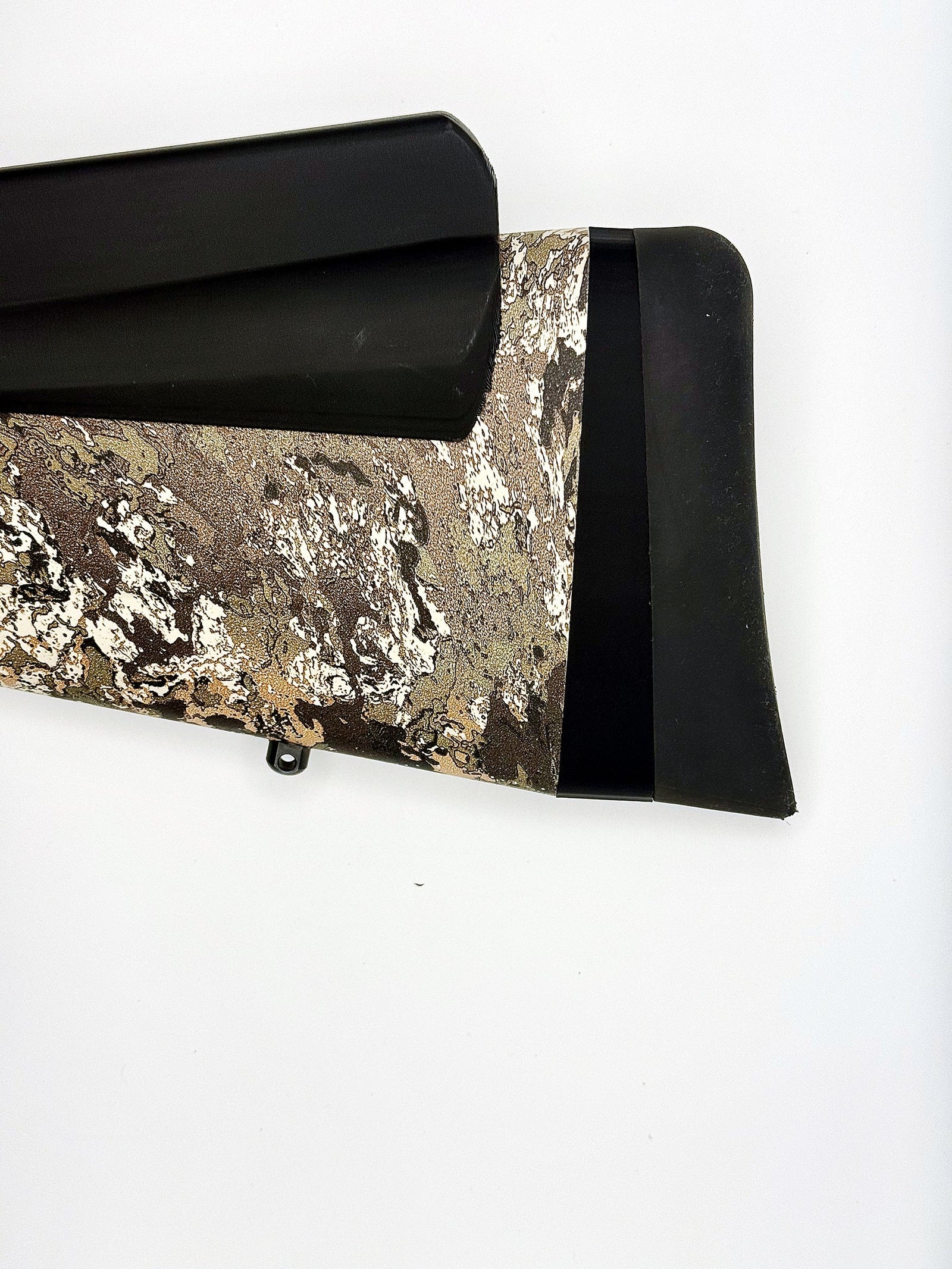
A stock does not remove recoil energy. What stock fit can change is how the rifle sits against your body: shoulder contact, cheek position, length of pull, and how consistently your head returns behind the scope. Start with the Tikka Fit Checklist before choosing cheek-height or stock-length parts.
Some rifles feel sharper than others even when the cartridge is the same. That does not mean the stock has changed the physics of the shot. It usually means the rifle is contacting the shooter in a different way.
For a scoped Tikka factory stock, the most useful question is simple: does the rifle put your shoulder, cheek, eye, and trigger hand in the same repeatable position every time?
Recoil energy and recoil feel are different things
The cartridge, rifle weight, projectile, and powder charge set the rearward impulse. Stock fit does not make that disappear. A more honest way to think about stock design is distribution: where the force lands, how stable the rifle feels in the shoulder, and whether your cheek weld is repeatable behind the optic.
That matters because the shooter is part of the system. If the stock is too short, too long, too low at the comb, or awkward behind the scope, the same rifle can feel harder to manage.
Length of pull changes shoulder contact
Length of pull controls where the butt pad sits and how naturally your trigger hand reaches the rifle. If the stock is too short, the rifle can feel cramped and your face may crowd the scope. If it is too long, you may stretch into the trigger and lose shoulder contact.
Check length of pull in the clothing and positions you actually use. If the checklist shows the compatible stock is short after eye relief is set, the LOP Spacer Kit is the Nokka stock-length path.
If your fit check shows that the stock still needs more length and pad angle is also part of the shoulder-contact issue, the Flat-Recoil LOP Spacer is the pad-angle length-of-pull option for compatible Tikka T3, T3x and T1x OEM stocks. It adds the selected spacer size while changing how the recoil pad meets the shoulder. It does not remove recoil energy, and it does not guarantee less muzzle movement; use the checklist first if you are unsure whether length of pull, cheek height, scope position or pad angle is the real issue.
Stacking rule for every LOP spacer: For every LOP spacer, use one spacer by default. Stacking any combination of LOP spacers can be done only in special cases, but a multi-piece stack does not create the strongest possible connection and is not our recommended default. If stacking is required, glue the spacer pieces together before final installation and use only the confirmed locating and fastening hardware for the setup. Contact us first if the stacked setup and hardware have not already been confirmed.
Comb height changes head position
Comb height controls where your eye sits behind the scope. If your cheek floats above the stock, the rifle can feel less controlled and your sight picture may be slower to find. If you press your head down to see through the optic, the mount position or ring height may need another look.
Close your eyes, mount the rifle naturally, settle your cheek, then open your eyes. If the sight picture is not centered, check cheek height before zeroing. For compatible factory-stock setups that need more cheek height, see the Drop Comb Cheek Riser.
Scope height can expose a stock-fit issue
A low factory comb may feel fine before the scope goes on. Once a medium or high optic is mounted, the same stock can put your eye below the scope centerline. That is a fit issue, not a cartridge issue.
Before changing parts, confirm ring height, eye relief, and cheek weld together. If both cheek height and stock length need work, the Performance Kit combines the Cheek Riser and LOP Spacer Kit for compatible setups.
Trigger feel still belongs in the setup check
Trigger feel does not change recoil energy, but it changes how confidently you break the shot. Confirm the rifle is unloaded before handling checks, follow the rifle manual, complete safe function checks, and use a qualified professional whenever you are unsure.
If trigger pull feel is still the issue after stock fit is sorted, check the Trigger Spring product fitment and safety guidance.
Use the checklist before buying parts
Do not diagnose recoil feel by buying the most expensive part first. Work through the setup in order: length of pull, cheek height, eye relief, trigger feel, then zero.
- For diagnosis: Tikka Fit Checklist
- For cheek height: Drop Comb Cheek Riser
- For stock length: LOP Spacer Kit
- For cheek height and stock length together: Performance Kit
- For trigger pull feel after fit is sorted: Trigger Spring
Run the Tikka Fit Checklist ->
Frequently asked questions
Can a stock reduce recoil energy?
No. The cartridge and rifle system set recoil energy. Stock fit changes how the rifle contacts the shooter and how repeatable the shooting position feels.
Why does my scoped Tikka feel harder to manage after mounting an optic?
The scope may have raised the sight line above your natural cheek weld. Check ring height, cheek height, and eye relief before changing other parts.
Does length of pull affect recoil feel?
It can affect how the rifle sits in the shoulder and how naturally you reach the trigger. Check length of pull after eye relief is set, then add length only if the stock is actually short for you.
Should I change cheek height before zeroing?
Yes. Set cheek height and eye relief before the final zero. Changing head position after zeroing can change how consistently you see through the scope.
Make your Tikka fit you
The Drop Comb Cheek Riser and LOP Spacer Kit, bundled and set up to work as a system — at a price that beats buying them separately.

